Not every building comes in a neat rectangle. Airports, sports complexes, railway stations, warehouses with curved walls, these structures are increasingly common across India. And when the building shape gets complex, the roofing challenge gets bigger too. So, how do you design a reliable steel roofing solution for a building that does not follow standard geometry? The short answer is: with the right planning, the right system, and the right team.
Most standard roofing systems are designed with flat or uniformly sloped surfaces in mind. The moment you introduce curves, angles, multi-level spans, or unusual footprints, things get complicated quickly. Rainwater does not flow as predictably, load distribution changes across different sections of the structure, and standard off-the-shelf roofing panels often simply do not fit.
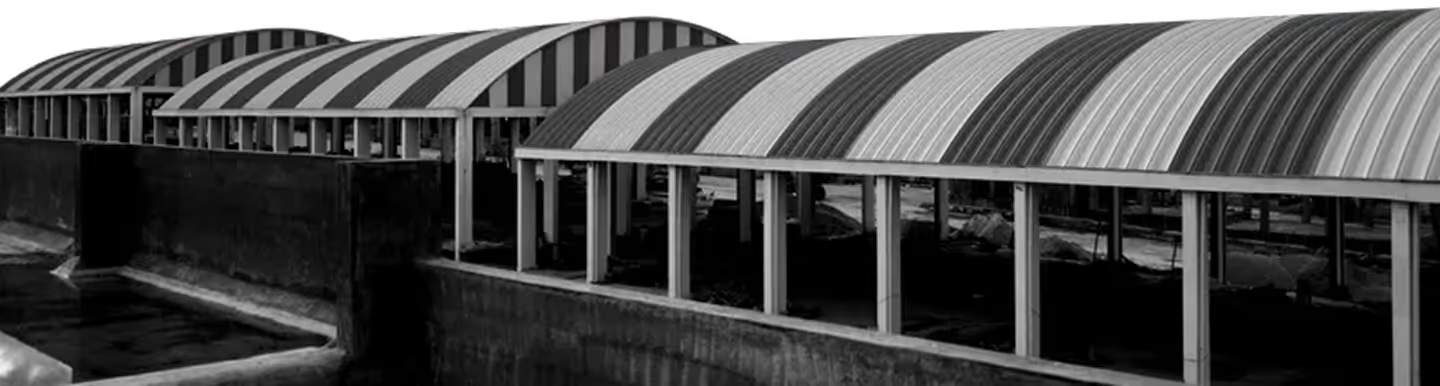
Steel is one of the most adaptable materials available for complex roofing projects, and that is precisely why it works so well for buildings with unusual shapes. Cold-rolled steel panels can be formed into curves, arches, and barrel vault profiles without requiring heavy additional structural support underneath. This gives engineers far more freedom when working with non-standard building layouts.
Another significant advantage is that steel panels can be produced directly at the construction site using mobile manufacturing units. This means panels are fabricated to match the exact dimensions of the building — not cut down from a standard size and forced to fit. The result is a cleaner, tighter, and more reliable installation.
Self-supported steel roofing systems are especially well suited to irregular layouts. Because the roof structure carries its own load without relying onintermediate columns or heavy trusses, designers have the flexibility to span large orirregular areas with far fewer structural constraints below.
Yes, and that is where careful, upfront planning makes all the difference. For irregular buildings, a proper design process is not optional. It is the only way to ensure the finished roof performs the way it should. The process typically begins with a detailed site survey, where accurate floor plan and elevation data is collected before any design or fabrication work begins. From there, engineers plan the panel layout, map out drainage paths, and calculate load distribution across the unique geometry of the structure.
The goal is to make the entire roofing solution behave as one unified system even when the building beneath it is anything but regular.
Not all steel roofing systems handle complex shapes equally, and choosing the right typefor the job matters. Arch and barrel vault roofing is ideal for curved or dome-likestructures, since the arch profile naturally distributes load and channels water awayefficiently. Cantilever roofing works well where one side of the structure is open orextended, common in railway platforms, fuel stations, and parking areas. For buildingsthat need large open spans without internal supports, "A" shaped steel buildings offer aground-to-ground structure that eliminates the need for concrete columns altogether.Multi-level roofing systems handle buildings where different sections sit at differentheights, accommodating step-downs and level changes with ease.Each of these is a form of self-supported roofing meaning the steel panels carry theirown structural load without depending on additional internal columns.
Roofing an irregular building is not just about covering the surface. The details matter just as much as the structure itself. Ventilators, skylights, and wall cladding should be designed as part of the overall roofing plan not as afterthoughts added once the main roof is already in place. Getting these elements right from the start prevents costly rework later.
Material quality is equally important. High-quality Galvalume steel offers significantly better corrosion resistance and a longer service life compared to standard roofing material with a lifespan of 35 to 40 years in most conditions. And even on curved or irregular surfaces, modern steel roofing systems can be designed to accommodate solarpanel integration, making it easy to add renewable energy capability to any building.
Designing a roof for an irregular building is not a job for a generic, one-size-fits-all approach. It requires experienced engineers, flexible materials, and the ability to manufacture panels precisely for the structure at hand.
Proflex Roofing Solutions has been delivering custom roofing solutions covering everything from railway platforms and sports complexes to airports, industrial facilities, and large commercial buildings. With mobile manufacturing units that produce panels directly at the construction site, we ensure precision, speed, and a perfect fit regardless of how complex or unusual the building shape may be.

.png)