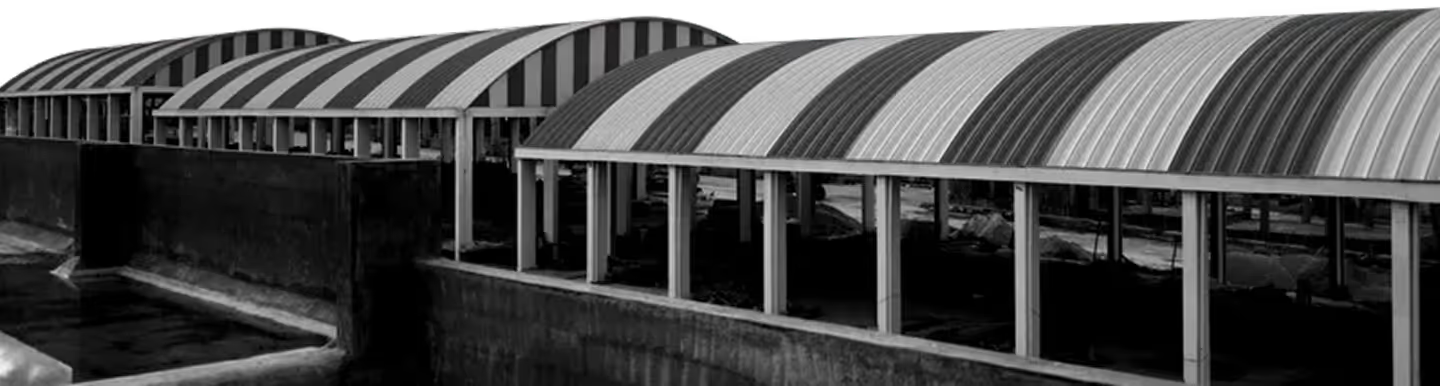
India's industrial energy costs are rising. Electricity bills for warehouses, factories, and logistics parks are among the biggest recurring operational expenses a building owner face. Rooftop solar is one of the most effective ways to reduce them and a self-supported steel roof is one of the best surfaces to do it on.
Here is a clear, step-by-step explanation of how it works on an arch-shaped, self-supported roofing system.
It helps to first understand why self-supported steel roofing and solar panels are such a natural pairing. Steel buildings are among the most structurally efficient surfaces for solar deployment. Their construction provides high-capacity load paths for mounting forces, and a regular surface geometry makes installation systematic and scalable. A self-supported roof adds another advantage: no internal columns mean the entire floor area stays operational while installation happens above with no disruption to the facility.
The 40 to 50-year lifespan of a Galvalume steel roof closely matches the 25-year operational life of a photovoltaic system meaning the roof will not need replacing before the panels pay back their investment.
Step 1: Structural Assessment
The first step in any solar integration project is a structural assessment of the roof. A solar array adds between 15 and 20 kg per square metre of dead load. For a self-supported roofing system, the assessment covers arch load-bearing capacity, wind uplift across the curved surface, and load distribution at the perimeter support beams.
We provide full structural load data arch reaction values and load combinations to the client's consulting engineer at project handover, making solar feasibility assessment straightforward from day one.
Step 2: Mounting System Selection
For mechanically seamed steel roofing panels, the recommended approach is a clamp-based, non-penetrating mounting system. Clamps grip the raised seams without drilling or any roof penetration fully preserving waterproofing and the Galvalume coating. No holes, no sealant patches, no leak risk.
Step 3: Panel Layout and Orientation
On a self-supported arch roof, the curved surface changes the sun-facing angle across the building width. Solar designers map usable surface area, identify optimal zones based on orientation and shading, and calculate expected yield. On an east-west oriented arch roof, the south-facing slope is used for the main array maximising generation hours per day.
Step 4: Electrical Integration
DC output is routed through inverters at ground level and converted to AC power for facility use. Most buildings built after 2000 handle electrical integration straightforwardly; older facilities may need minor panel upgrades.
A well-designed rooftop solar system on a self-supported steel roofing structure can offset a significant portion of a facility's electricity consumption reducing utility bills, supporting ESG targets, and delivering a return on investment typically within 5 to 7 years.Our steel roofing systems are designed with solar integration in mind and every project is solar-ready from day one.
Q1. Can solar panels be installed on any self-supported roofing system?
Yes, provided a structural assessment confirms the roof can handle the additional load. Our self supported roofing systems include full structural load documentation, making solar feasibility assessments straightforward.
Q2. Does solar panel installation require drilling into the steel roofing panels?
No. Clamp-based systems grip the seams of mechanically seamed steel roofing panels without penetration fully preserving waterproofing and the Galvalume coating.
Q3. How much electricity can a rooftop solar system on a self-supported steel roof generate?
Output depends on roof area, orientation, and panel efficiency. Most large industrial facilities with self-supported steel roofing can offset a substantial part of their electricity consumption.
Q4. Does installing solar panels affect the structural integrity of a self-supported roofing system?
Not when installed correctly. A properly assessed clamp- mount system distributes load within the design capacity of the roofing solution no compromise to the arch structure or perimeter supports.
Q5. Are your steel roofing systems solar-ready from the time of installation?
Yes. Every self-supported roofing system we deliver is solar-ready panels can be added at any stage of the building's lifetime without modifying the roof structure.